The holidays arrive whether you are ready or not. One day you are unpacking decorations, and the next you notice the silence where the jingling collar used to be — no paws padding into the kitchen during dinner prep, no tail sweeping ornaments off the low branches, no warm body across your feet during the long evenings. The first Thanksgiving and Christmas after losing a pet are genuinely harder than people expect, and if this year is your first, this guide is for you: how to plan ahead, what to do with the traditions, how to survive gatherings, and gentle ways to include your pet’s memory in the season without turning every celebration into a funeral.

Why the holidays hit harder than ordinary days
Grief is not a constant; it spikes around rituals. Psychologists call these moments “grief bursts,” and holidays are the densest cluster of them all year: familiar songs, particular smells — pine, cinnamon, roasting turkey — the rearranged furniture for the tree, houseguests who haven’t visited since last winter. Every one of these is a small time machine, and in year one, almost all of them lead back to your pet.
Two things are worth knowing before the season starts. First, this is normal and predictable — grief researchers consistently find anniversaries and holidays among the most intense grief triggers. Second, anticipation is usually worse than the day itself. The dread of Thanksgiving, for most people, turns out to be harder than Thanksgiving. Knowing the wave is coming lets you plan around it instead of being knocked down by it.
Decide the traditions before the day decides for you
The most useful thing you can do is spend ten minutes this week — before decorations come out — deciding, on paper, which traditions to keep, change, or skip this year. Unmade decisions ambush you mid-December; made decisions just execute. Go through your usual list:
- Keep as-is: traditions that comfort you even without them. Many families find that keeping the ritual intact — same dinner, same walk route — honors the pet better than canceling it.
- Change slightly: traditions that feel unbearable in their old form but still matter. If hanging the stocking is too painful, hang it with a note inside instead of gifts. If the tree was their territory, maybe put fewer low ornaments and set their photo on the tree skirt instead.
- Skip this year: traditions that are simply too much. It is completely legitimate to skip the office party, the neighborhood cookie exchange, or the trip — in year one, subtraction is a valid strategy, and you can revisit next season.
Write the decisions down and tell the people who live with you. A shared plan turns December from a minefield into a schedule.
Ways to include their memory (without hijacking the holiday)
Families almost always land on one small gesture that feels right — small is the key word. The goal is acknowledgment, not a memorial service at dinner. Some ideas that work well:
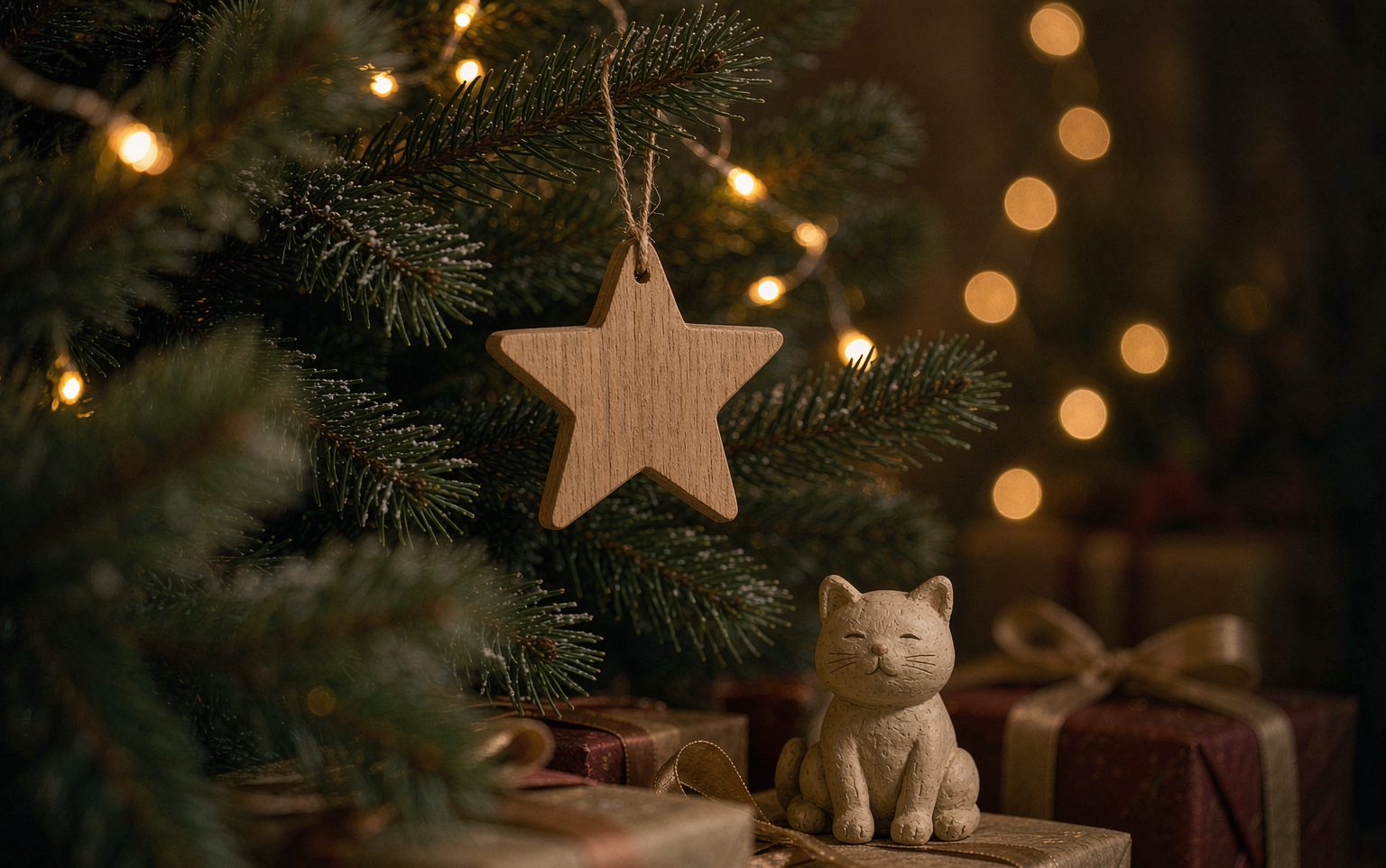
- An ornament for the tree. A simple ornament with their name, or a plain wooden one, hung low where they used to nap under the branches. Some families buy a dedicated ornament every year; it becomes the tradition itself. Our guide to pet memorial Christmas gifts has ornament and gift ideas if you want something made to last.
- A place setting or photo on the shelf. Their framed photo where the stocking used to hang, or a small framed picture among the garland.
- A moment before the meal. One sentence before dinner — “before we eat, a thought for Biscuit, who would have been under this table right now” — takes ten seconds and prevents the unspoken ache at the table.
- A candle. Lit on the day itself, on the windowsill or shelf where they slept.
- A gift in their name. Donating supplies to the shelter they came from, in the week of the holiday, converts grief into something the season is actually about.
What matters is choosing one, not performing grief. If a gesture starts to feel like an obligation, shrink it or skip it — it is supposed to serve your healing, not audit it.
Surviving the gatherings
Holiday parties and family dinners are their own challenge, because other people are unpredictable. Most will be kind; some will say the wrong thing — “it was just a dog, get another one” is a sentence people actually say. Prepare two or three graceful exits from the conversation in advance, such as: “Thanks — I’m not really ready to talk about getting another one yet.” You do not owe anyone emotional labor at a party.
Give yourself permissions, explicitly:
- Permission to leave early. Drive your own car or arrange your own ride so the exit is always yours.
- Permission to step out. A two-minute breather on the porch mid-dinner is invisible to everyone else and reset everything for you.
- Permission to not go. If a specific gathering is more obligation than joy this year, declining is a complete sentence.
And if you find yourself actually enjoying a moment — laughing at dinner, humming along to a song — let it happen without guilt. Joy during grief is not betrayal; it is the first proof that the season will be livable again. Grief and laughter coexist all winter; they are supposed to.
If children are part of your holiday
Kids often grieve the pet in bursts that look, from the outside, like nothing — then a question at the Christmas tree lot levels you both. Let them lead: if they want to hang the pet’s ornament, let them; if they want to skip it, skip it. Answer questions honestly and briefly, and include them in the one-ritual decision — a child who chooses “we leave carrots out like always” is doing real grief work. Our fuller guide to helping a child cope with pet loss covers the deeper conversations.
Plan the hard dates specifically
In year one, grief clusters around specific dates, and it helps to treat them like weather forecasts — known storms, planned around. Mark on a calendar: the pet’s birthday or gotcha-day, the anniversary of their death (our guide to pet loss anniversary rituals covers that day itself), and this year, the first Christmas morning without them. For each, decide in advance: who will be around, what you will do that morning, what you want to avoid. A plan is not weakness; it is scaffolding that holds the day up until it can stand on its own.
When the season becomes a turning point
Somewhere in this first season, most grieving families notice something shift: a memory surfaces with warmth attached instead of only pain. That is the grief integrating, and small physical rituals accelerate it. Lighting the candle. Hanging the ornament. Sitting with a keepsake for a minute before guests arrive — for many of our customers, that is where a custom clay figurine sculpted from photos lives: on the mantel among the holiday greenery, present at the celebration the way they always were. If you are still choosing how to keep them close, our guides to personalized memorial gifts and anniversary remembrance ideas cover the fuller picture.
And if the season is simply heavy — if you are dreading the next six weeks in a way that feels bigger than the holidays — that is worth taking seriously too. Our overview of coping with pet loss includes support resources, and there is no shame in leaning on them during the hardest season of the hardest year.
Frequently asked questions
Should I get another pet before the holidays to fill the space?
Almost never on that timeline. A new pet is a new relationship, not a replacement, and bringing one home mid-holiday chaos tends to be hard on both the animal and your grief. Most guidance suggests waiting until the acute grief settles — often several months — and until the decision comes from wanting a new companion rather than from plugging a hole. The empty bed by the fire is hard; filling it too fast usually makes it harder.
How do I handle the pet’s stocking, bed, or food bowl during decorating?
There is no rule — only what your family can live with. Some families put these things away before the season starts because leaving them out is too raw; others keep the stocking up and hang it with a card inside. Whichever you choose, decide deliberately (see the tradition exercise above) rather than being ambushed by the item on decorating day.
What do I say when guests ask about the empty spot or the photo?
One honest sentence is enough, and you get to choose its depth: “We lost her in October — first holiday without her,” or, if you would rather steer away, “She was part of every Christmas here — we’re keeping her ornament up.” Most guests follow your lead. The ones who push deserve the second sentence, not your composure.
Is it normal for the grief to spike again at the holidays even if I was doing better?
Yes — completely. Grief is nonlinear, and holidays, anniversaries, and songs reliably reopen it even after months of steady days. A December wave after a calm autumn does not mean you have gone backward; it means you loved someone who belonged to this season too. The waves shorten with time, and planning for them (rather than being surprised by them) takes most of their power away.
For more on the days and decisions around a loss, start with our guide to coping with pet loss and our collection of pet memorial quotes for words when yours run out.
A note from our studio
We are a small studio, and everything here is made to order — from a hand-sculpted clay portrait to a printed keepsake that carries a single photograph. Nothing on this site is stock waiting in a warehouse. That is why a piece takes two to four weeks instead of two days.
It also means we are the ones who open the emails. If you write to us about a pet you lost, you are not reaching a support queue — you are reaching the people who will be holding the work in their hands.
And if you have a story you would like to tell, whether or not you ever order anything, there is a place for it here: Share your story. We read every one ourselves, and nothing is published without your permission.
If you are reading this in the first hard weeks: we are sorry. Take the time you need.
— Fingking Studio