Somewhere between the last walk and the first quiet morning, many of us realize we never said anything out loud. We thought it — all of it — but we never gathered the memories into words. A pet eulogy is that gathering. It is a short, spoken tribute to a dog or cat who mattered, and writing one is less about being a good writer and more about being willing to remember honestly. This guide walks you through what to include, what to gently leave out, how to structure it, and how to deliver it without falling apart — with two full examples and a fill-in-the-blank template you can adapt tonight.
What a pet eulogy is (and why the words matter)
A eulogy is simply a spoken or written tribute delivered at a memorial, a graveside gathering, a cremation service, or even alone in a parked car. In the pet world it is usually shorter than a human eulogy — three to five minutes, or roughly 400 to 800 words — and far less formal. There is no pulpit and no dress code. Some people read theirs at a backyard gathering under the tree their dog always shaded; others record a voice memo they never intend to share with anyone.
The act matters more than the audience. Grief researchers have long noted that ritual and narrative help mourners make sense of an abrupt loss, and pets die abruptly more often than not — a diagnosis on Tuesday, a goodbye on Thursday. Writing a eulogy forces the story into a beginning, a middle, and an end, which is exactly the shape grief resists. Many people who write one keep it for years afterward, rereading it on the anniversary or when the house feels too quiet.
When a eulogy fits — and when something shorter works
A full eulogy fits naturally if you are holding a memorial service, burying or scattering ashes with family present, or taking part in a crematory’s farewell moment. Our guide to pet memorial service ideas shows how a reading usually anchors the middle of such a gathering.
But a eulogy does not require an event. If you are grieving privately, a eulogy can simply be a letter you read aloud at home — some people read theirs at the pet’s favorite spot: the end of the garden, the sunny windowsill, the passenger seat. And if sitting down to write feels impossible right now, something shorter is fine. Reading one meaningful line from our collection of pet memorial quotes, or simply saying “thank you, I loved you, I’m sorry, goodbye,” is a complete ritual for some days. The eulogy can come weeks later, when the words arrive.
Before you write: gather the raw material
Do not start with a blank page. Start with a list. Give yourself twenty minutes with a notebook and jot down, without polishing anything:
- Three specific memories — not “she was sweet,” but “she carried one sock upstairs every night and lined them up by the bed.” Specifics are what make a eulogy feel alive.
- The beginning — where the pet came from: a shelter, a breeder, a cardboard box outside a grocery store, a friend’s litter.
- A daily ritual you shared — the 6 a.m. wake-up, the after-school sprint to the door, the slow evening walk that got slower over the years.
- One flaw you loved — the barking at the vacuum, the destruction of two houseplants, the judging stare at dinner. Flaws are what make the tribute believable.
- The goodbye — what the last day or moment was like, if you feel ready to include it.
That list is your inventory. A eulogy is not a biography; you will use only a fraction of it, and that is the point.
How to structure a pet eulogy
Most eulogies that feel “right” follow the same quiet architecture. You do not need to label these parts — they simply sit in this order:
1. The opening — name them and say what they were. One or two sentences. “Biscuit came to us from the county shelter in 2014, and for eleven years she was the smallest, loudest member of this family.” You have told the audience who is being remembered and set the tone in one breath.
2. The body — two or three stories, one flaw, one ritual. Pick your best three memories from the list and tell each in three or four sentences. Weave in the daily ritual, because rituals are where an audience recognizes its own grief. Then name the flaw and let people laugh — laughter at a pet memorial is not disrespect; it is relief, and it is how most of us actually loved them.
3. The closing — gratitude and goodbye. Two or three sentences. Say thank you — for the years, the walks, the company during hard seasons. Then say goodbye in your own words. It does not need to be poetic. “Goodbye, old girl. The house will be quieter and we will be worse at it.”
That is the whole skeleton. Roughly 10% opening, 70% stories, 20% closing.
What to include
- The origin story. Every pet has one, and audiences lean in for it.
- One or two sensory details. The smell of rain on his coat. The sound of her purr against your ribs. Sensory details carry more emotion than adjectives.
- The other beings in the house. How the cat tolerated the dog. How the kids grew up. Pets exist inside families; naming that widens the tribute.
- What they taught you. Patience, routine, forgiveness of small disasters. One sentence is enough — more becomes a lecture.
- One line of direct address. Somewhere near the end, speak to the pet directly: “Thank you for waiting by the door every single day.” This is the emotional peak, and it should come late.
What to gently avoid
Nothing is forbidden — this is your goodbye — but a few habits tend to make eulogies feel flat or, worse, add guilt to an already heavy room:
- A endless list of adjectives. “She was loyal, loving, sweet, kind, gentle…” — one story proves more than five adjectives.
- Medical detail beyond what serves the story. Name the illness once if you need to; the audience does not need the timeline of treatments.
- Guilt narratives. “I should have noticed sooner” is a thought for a therapist, a journal, or a vet conversation — not for a tribute. The room cannot absolve you, and the eulogy is not the place to ask it to.
- Apologizing for crying. You will not cry gracefully and neither will anyone else. Pause, breathe, continue. Nobody remembers the pause; they remember the story.
Example: a short eulogy for a dog
Rufus arrived in 2013 as a foster who failed — the shelter said lab mix, the vet said maybe some hound, and the truth was he was mostly stomach. He could hear a cheese wrapper from the second floor with the TV on.
For nine years Rufus ran this house on a schedule of his own design. Six-fifteen: breakfast negotiation. Seven: the school walk, where he escorted the kids to the corner like it was a paid position. Evenings: the couch, the heavy sigh, the full-body lean against whoever had had the hardest day — he always knew which one of us that was.
He was not perfect. He ate an entire birthday cake in 2017, frosting first. He barked at the mailman with a conviction he reserved for nothing else. He shed on every garment we own and we found white hair in the laundry for years after the last wash.
What Rufus taught this family is that showing up is the whole job. Every day he showed up — at the door, at the couch, at the low moments when a person just needed something warm leaning against them.
Goodbye, big guy. Thank you for every morning. The cheese drawer will stay unlocked in your honor.
— about 220 words, roughly two minutes spoken.
Example: a short eulogy for a cat
Clementine chose us the way cats do — she appeared on the porch one October, ate half a sausage, and simply never left. The vet guessed she was two. She owned this house for sixteen years after that.
She was not a lap cat, and that is part of what made her memorable. Affection from Clementine was rationed like wartime sugar: a single slow blink from across the room meant you had been chosen that day, and everyone in the family knew to be quietly proud. She slept in the laundry basket, supervised all cooking from the kitchen doorway, and held a seventeen-year grudge against the vacuum cleaner.
In 2020, when our lives came apart for a while, she did something she had never done: she climbed onto a lap and stayed. For a month she was there every evening, warm and heavy, asking nothing. Cats grieve with us in their own currency, and she paid out exactly what was needed and went back to the laundry basket.
Goodbye, sweet girl. The kitchen doorway is empty and we look up anyway.
— about 200 words.

A fill-in-the-blank template
If the examples above feel out of reach tonight, use this frame. Write one sentence per line and you will have a complete, honest eulogy in under an hour.
Name came to us in year from shelter / breeder / street / a friend, and for number years he/she was one true sentence about who they were.
Every day looked like the ritual you shared. He/She was famous in this house for one specific habit and for one more specific memory.
He/She was not perfect: the flaw you loved. He/She taught us one lesson in one sentence.
Thank you, name, for the thing you are most grateful for. Goodbye, name. One closing line in your own voice.
Read it aloud once alone before the gathering. Any line that trips your tongue three times gets shortened — spoken language is simpler than written language.
Delivering it without falling apart
First, expect to cry and plan around it. Print the eulogy in a large font on one page rather than reading from a phone screen, and underline the first three words so your eyes have a place to return after a pause. Slow down: grief-speed reading runs fast and breathless on purpose, because finishing feels safer than feeling. Consciously slow to about two-thirds of your normal pace.
Second, deputize a backup. Ask one steady person beforehand: “If I can’t finish, will you read it?” Knowing the exit exists makes the exit unnecessary. Most people who plan for a bailout end up reading every word themselves.
Third, it is allowed to be imperfect. A cracked voice mid-sentence is not a flaw in the tribute — to everyone listening, it is the most honest sentence in it.
If children want to take part
Children old enough to write can contribute a sentence or two of their own — a favorite memory, a drawing held up while a parent reads their words. Our guide to helping a child cope with pet loss covers the emotional ground; for the eulogy itself, the rule of thumb is: let them say one true thing, in their words, even if it is “I miss when she slept on my homework.” Adults in the room will remember that line longer than anything polished.
After the eulogy: keep the words somewhere real
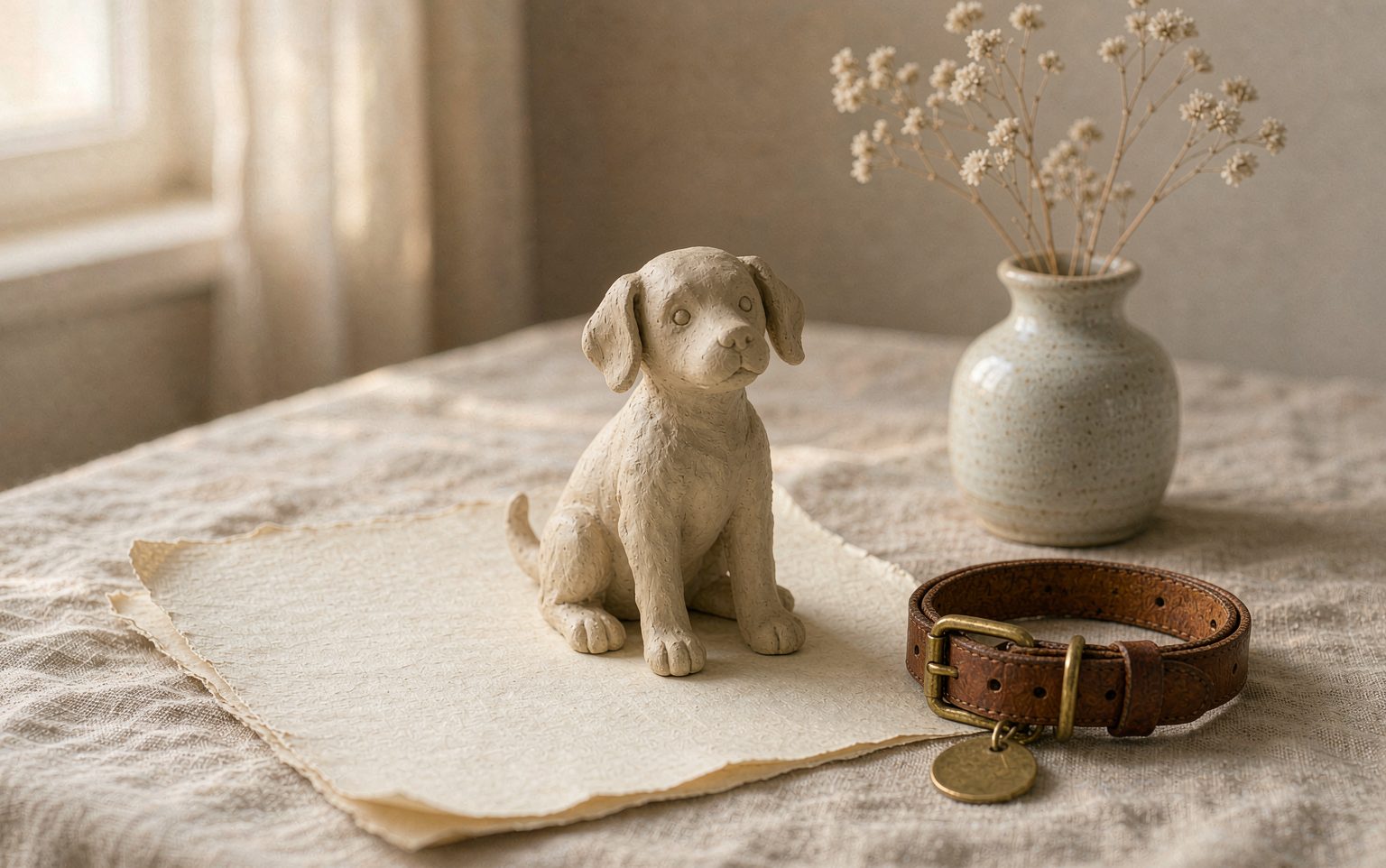
However you deliver it, keep it. Emailed to yourself, printed and framed beside a photo, read once a year — a eulogy becomes more valuable with time, not less, because it is the one document from that week that holds the whole animal: the sock thefts, the cheese drawer, the slow blink. Some families tuck a printed copy into the box with the collar. Others pair the reading with a permanent keepsake — for many of our customers, a custom clay figurine sculpted from photos sits on the shelf where the eulogy is read, and the two together turn a hard afternoon into something that lasts. If you are still deciding how to honor your pet, our guides to memorializing a dog and cat memorial ideas cover the fuller picture.
And if the words have not come yet, that is not failure. Some eulogies are written the night before the service; some are written six months later at a kitchen table. The pet is not waiting on a deadline. Whenever the words arrive, they will be enough.
Frequently asked questions
How long should a pet eulogy be?
Three to five minutes spoken, which is roughly 400 to 800 words written. Shorter is completely fine — a two-minute tribute delivered with a steady heart beats a rambling ten-minute one. If you are the sole speaker at a family gathering, aim for the shorter end and let conversation and stories flow afterward.
Can I read a poem instead of writing a eulogy?
Yes, and many people do. A reading from our pet memorial quotes collection, a poem, or a passage that reminds you of your pet is a complete tribute. What makes it personal is one added sentence of your own — “that was our Biscuit exactly” — which turns borrowed words into a goodbye.
What if I start crying and can’t finish?
Pause, breathe, sip water, and resume where you stopped — the audience will wait, and the pause reads as love, not failure. This is why printing the eulogy and asking someone in advance to be ready to finish it for you matters. If you truly cannot continue, hand over the page; the tribute still happened.
Is it strange to hold a eulogy for a pet?
No. Rituals for pets are increasingly common — veterinary associations acknowledge that the human-animal bond is a genuine attachment loss, and therapists treat pet grief as real grief. A eulogy is simply a structured way to do what mourners have always done: tell the story out loud, among people who understand.
Should I mention the euthanasia?
Only if you need to, and briefly. Many eulogies say nothing beyond “we said goodbye at home, in her favorite chair.” The medical details belong to private conversations. If guilt is part of your grief, our piece on coping with pet loss addresses it directly — but the eulogy itself works best as a story of a life, not an account of its final days.
If you are planning the goodbye itself, start with our pet memorial service ideas, then come back to this page when it is your turn to speak.
A note from our studio
We are a small studio, and everything here is made to order — from a hand-sculpted clay portrait to a printed keepsake that carries a single photograph. Nothing on this site is stock waiting in a warehouse. That is why a piece takes two to four weeks instead of two days.
It also means we are the ones who open the emails. If you write to us about a pet you lost, you are not reaching a support queue — you are reaching the people who will be holding the work in their hands.
And if you have a story you would like to tell, whether or not you ever order anything, there is a place for it here: Share your story. We read every one ourselves, and nothing is published without your permission.
If you are reading this in the first hard weeks: we are sorry. Take the time you need.
— Fingking Studio