A paw print is one of those things you never think to keep until you can’t make one anymore. Most of us have hundreds of photos and not a single print — and unlike a photograph, a paw print is physical. You can press your thumb into the same clay your dog’s foot pressed. A paw print keepsake is one of the few memorials you can genuinely make yourself, in an afternoon, for a few dollars.
This guide covers the whole process honestly: what to ask your veterinarian before a goodbye appointment (this part matters most, and hardly anyone tells you), how to make a clay impression or an ink print at home step by step, what to do if cremation has already happened, and how to keep a finished print safe for decades. You’ll also find an honest note about what we sell and what we don’t — we don’t sell paw print kits, and this guide works fine without buying anything from us.
In this guide
Why Paw Prints Make Good Keepsakes
A photograph captures how your pet looked. A paw print captures something a photo can’t: contact. It is the exact shape of the feet that walked your floors, left muddy prints on the kitchen tile the day it rained, and pressed against your chest when they stood up to greet you. Their pads also carry their own story — the size, the spread, the wear marks of a dog who loved one particular walking route, or the tiny neat print of a cat who ruled the bookshelf.
There are two practical reasons paw prints work so well as memorials, too. First, they are one of the only keepsakes you can make yourself, which matters to a lot of people — the act of pressing the clay is part of the remembering. Second, they can involve children: a child may not want to talk about death, but almost every child will happily press a paw into clay, and that becomes their own way of holding on. If there are kids in the house, our guide to helping a child cope with pet loss pairs well with this one.
Start Here: If You Still Have Time
If your pet is still with you — whether you’re facing a planned euthanasia date or you simply have an old dog and a feeling — this is the section that matters. A physical paw print can only be taken while your pet is alive or very shortly after death. Once cremation has happened, it is too late, and there is no way to recover it. Everything else in this guide can be done later. This part can’t.
Ask your veterinary clinic in advance
Many veterinary clinics will take a paw print for you as part of end-of-life care — most commonly an ink print on card, sometimes a clay impression. But policies vary from clinic to clinic, and they can only say yes if you ask. Call a day or two before the appointment and say plainly: “We’re saying goodbye to our dog on Thursday. Would you be able to take a paw print for us, either ink or clay?” This is a routine request for them. You are not asking for anything strange, and clinic staff are generally glad to do it.
What you can ask for
- An ink print — the clinic presses your pet’s clean, dry paw onto a non-toxic ink pad and then onto card. Quick, clean, and easy to frame.
- A clay impression — a disc of soft clay pressed with the paw, which you take home to dry. A few clinics keep clay on hand; if yours doesn’t, you can bring your own (see the clay section below).
- A fur clipping or whisker — not a paw print, but many families ask for a small lock of fur at the same time, and it costs nothing to request.
One honest caution: if you are taking the print yourself at home in the final days, wait for a calm moment. A stressed pet produces a smudged print and a bad memory, and no keepsake is worth that. If your pet is anxious, the print can wait an hour. If you are managing a death at home, our step-by-step guide to what to do when your pet dies at home covers the immediate practical steps, and what to say to someone who loses a pet covers the conversation if the pet belongs to a friend.
If Cremation Has Already Happened
Let’s be honest, because vague comfort helps nobody here: if your pet has been cremated, a physical paw print is no longer possible. Cremation happens at very high temperatures; nothing of the paw remains. Some crematoriums offer prints taken before cremation — if your pet is at the crematorium right now rather than already returned to you, call them immediately and ask. Many will have taken one as standard practice, and it costs nothing to find out.
If it’s genuinely too late, you still have real options, just different ones. Prints your pet left behind in everyday life can sometimes be captured: paw marks in cold pavement frost, dusty window ledges, or the nose and paw smears dogs leave on glass doors and car windows. A clear, well-lit photo of those marks preserves them — it isn’t the same as a physical print, but it is genuinely theirs. And anything made from photographs remains fully available: a hand-sculpted figurine or a custom portrait built from your pictures doesn’t depend on timing. Our guide to what to do with your pet’s ashes covers the keepsake options that exist after cremation.
How to Make a Clay Paw Print Impression
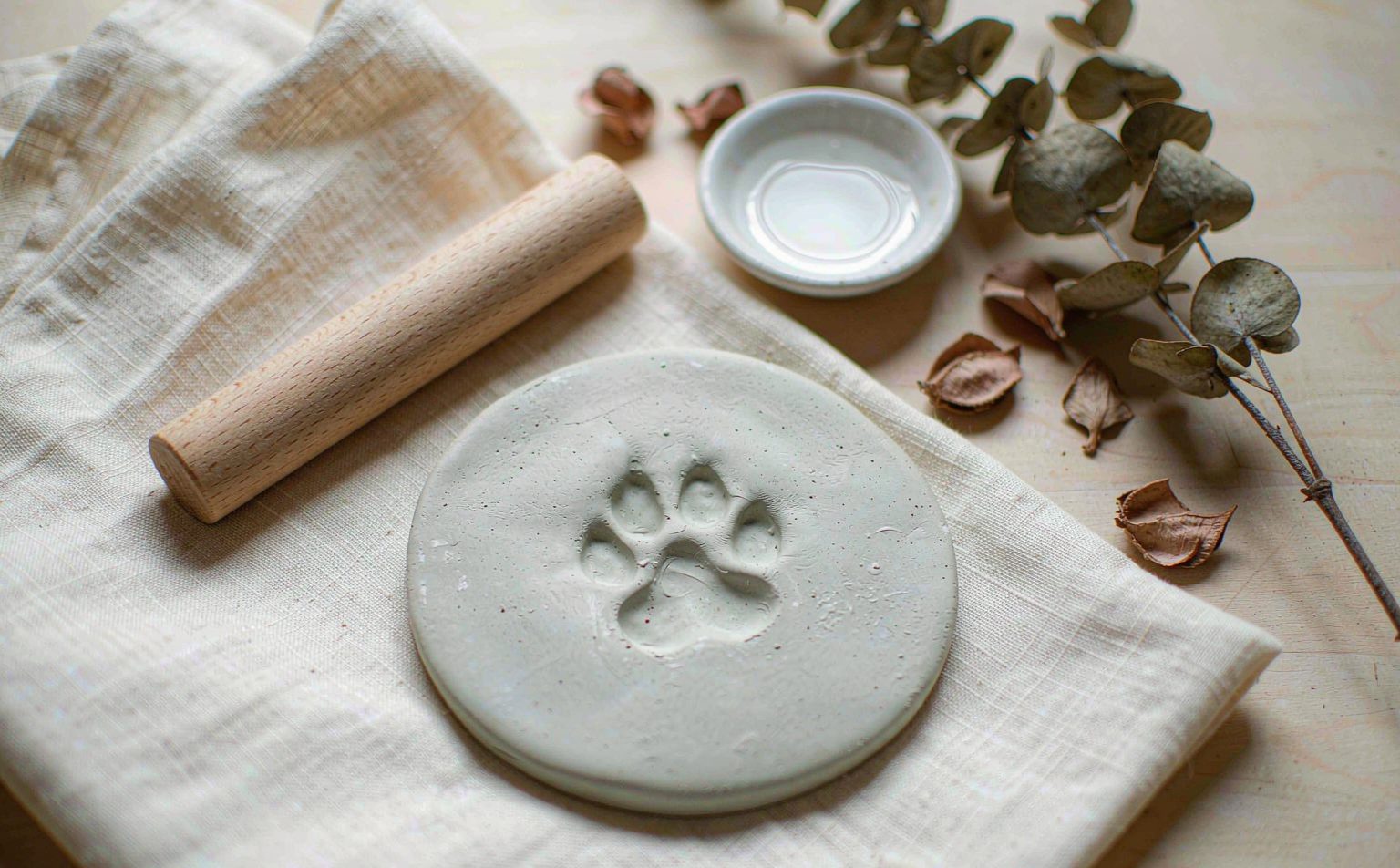
Clay is the most durable DIY option and the most forgiving. You need: a block of air-dry clay (any craft store, a few dollars), a rolling pin or a smooth bottle, a knife, and a afternoon. Don’t buy polymer clay for this — it must be baked to harden, which adds a failure point you don’t need.
Step by step
- Knead and roll. Work the clay in your hands for a minute until it’s soft and uniform, then roll it into a disc roughly half an inch (1–1.5 cm) thick. Thinner discs crack; thicker ones take days to dry.
- Smooth the surface. A barely-damp fingertip passed lightly over the top removes tool marks and gives a cleaner print.
- Prep the paw. Make sure pads are clean and dry. If your pet has fluffy feet, you can lightly trim the fur between pads with small scissors — a light trim, never a shave — or simply press firmly and accept a softer-edged print.
- Make the print. Support the leg comfortably, press the paw straight down into the clay with even, gentle-firm pressure, and lift straight up. Pressing at an angle is the most common cause of a smudged print. For cats, gently extend a paw by pressing the toe pads from above — calmly, or not at all.
- Fix the small stuff. A fingerprint at the edge can be smoothed with a damp brush. A name and date can be scratched in with a toothpick now — lightly, because deep carving can crack the disc as it dries.
- Dry it slowly. Air-dry clay needs roughly 24–72 hours depending on thickness and humidity. Turn it occasionally so the underside dries too, and keep it away from radiators and direct sun, which cause cracking.
- Seal it. Once fully dry, a coat of clear acrylic sealer (spray or brush-on) protects it from moisture and decades of shelf dust. Don’t seal it while any part is still damp — trapped moisture is what makes keepsakes crack later.
The six mistakes that ruin a clay print
- Clay too thin or too wet — it cracks or slumps as it dries
- Pressing too hard — the print goes through the disc and distorts
- Lifting the paw at an angle instead of straight up
- Drying it fast on a radiator or in sunlight
- Sealing before it’s fully dry
- Waiting for the “perfect calm moment” until there isn’t one — a slightly soft print made on a good afternoon beats a perfect one that never got made
How to Make an Ink Paw Print
Ink prints take five minutes and frame beautifully — this is the option behind most framed paw prints you see. You need: a water-based, non-toxic ink pad (a large stamp pad, or pet-paw-print kits sold at pet stores), stiff paper or light card, damp cloths, and a treat supply.
- Choose your moment — after a nap is ideal. Calm pet, calm you.
- Press the paw into the pad evenly, or press the pad lightly onto the paw — whichever is less alarming to your animal.
- Press the paw onto the paper straight down, hold two or three seconds, lift straight up. Slightly stiff paper gives a crisper edge than printer paper.
- Make several. Take three or four prints in one session and keep the best one. If one smudges, you have spares.
- Clean up immediately — warm water, mild soap, towel dry, treat. Water-based ink washes off easily; never use solvent-based or permanent ink pads, which are neither skin-safe nor necessary.
Common fixes: if the print looks patchy, the pad was too dry or the press too light — re-ink and try once more rather than scrubbing the same print. If the toes didn’t take ink, press the pad more firmly into the toe pads next time. And if your pet flatly refuses, stop. An ink print made through a struggle isn’t a good memory, and there are other ways — see the honest alternatives below.
The Salt Dough Option, Honestly
Salt dough is the classic family craft — a basic recipe is two parts flour, one part salt, one part water, kneaded into a dough, pressed with the paw, then dried out in a low oven until hard. It costs almost nothing, which is why it dominates school crafts and family ornaments.
Two honest cautions before you choose it. First, it is brittle: salt dough prints chip and crack far more easily than clay, and they soften in humidity — not ideal for a keepsake meant to last decades. Second, and more importantly: salt dough is dangerous if eaten by dogs. The salt content is high enough to cause salt toxicity in pets, and a salt-dough ornament on a low shelf is exactly the kind of thing a dog will eat. If your household includes a living pet or a child who chews things, choose air-dry clay instead. If you do use salt dough, dry it thoroughly and keep it on a high shelf.
What to Do With the Print Once You Have It
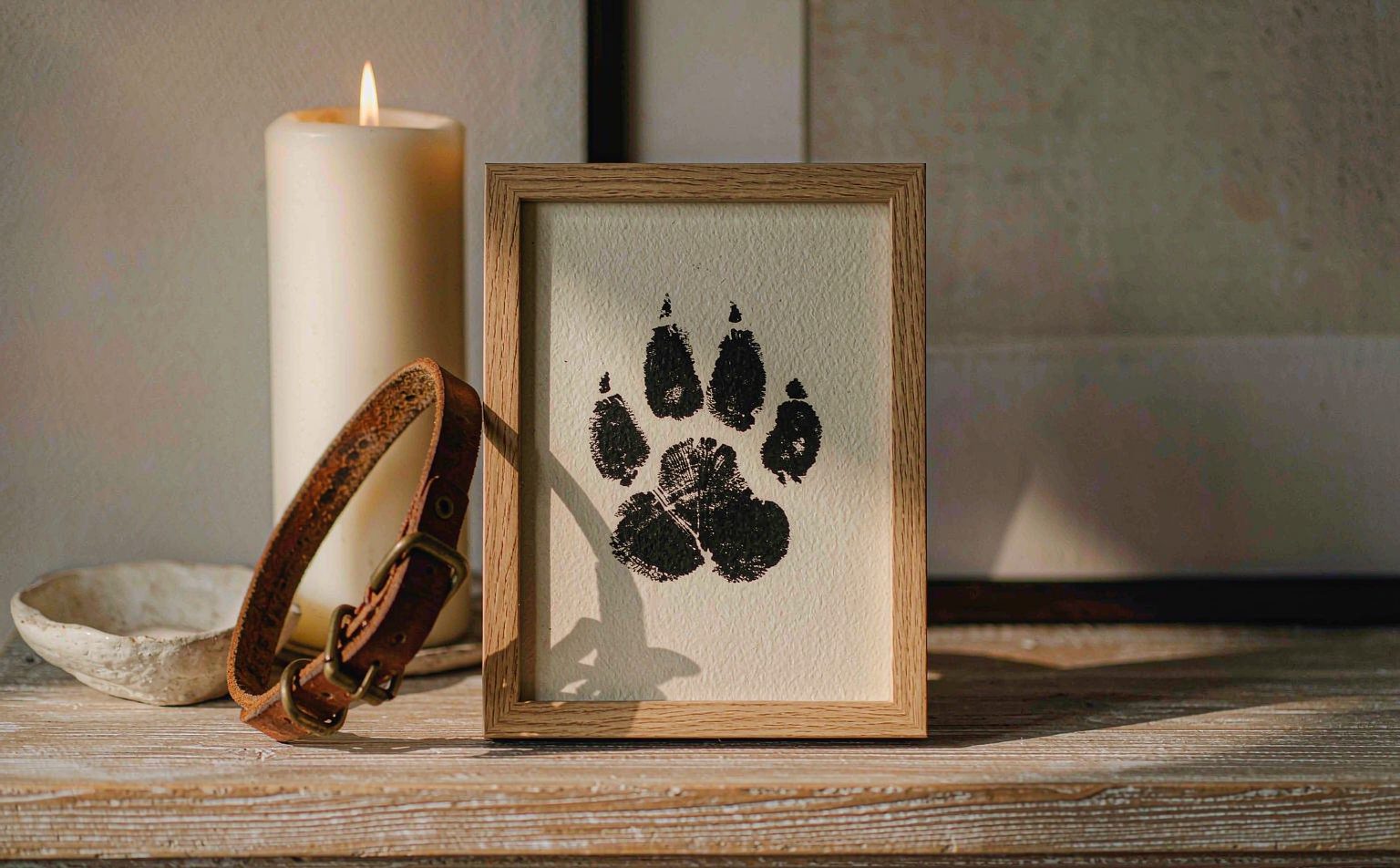
- Frame it. An ink print on card, in a simple frame, is quietly powerful — especially beside a candle or their collar. This is the version that sits on mantels for twenty years.
- Add it to a memory box. Prints, a lock of fur, a tag, a favorite toy — our guide to what to do with your pet’s belongings covers how families organize these.
- Turn it into a holiday ornament. A clay print with a hole punched through the top (a drinking straw does it) becomes a Christmas ornament after drying. Our guide to pet memorial Christmas gifts has more on ornaments and honest alternatives.
- Have it engraved. If you’re commissioning anything engraved — an ID tag or the base of a wooden keepsake urn — a paw print motif alongside the name is a classic detail. Ask the maker before assuming any shop can engrave an exact print shape; stylized paw outlines are always achievable, exact replications depend on the equipment.
- Tattoo reference. Many memorial tattoos start from a real print rather than a generic design. A clean, high-contrast ink print scanned at high resolution gives a tattoo artist exactly what they need.
Caring for a Paw Print Keepsake Long-Term
A clay print can easily outlive the shelf it sits on if you follow three rules. Keep it dry — humidity softens air-dry clay and salt dough, so bathrooms and windowsills above kettles are the wrong rooms. Keep it out of direct sunlight, which fades engraved ink and can discolor clay over the years. And don’t clean it with water — a dry, soft brush or a breath of air is all it ever needs; water reactivates unfired clay and will ruin the surface. Ink prints on paper need even less: frame them behind glass, keep them out of sunlight, and they will not fade meaningfully in your lifetime.
If you’re keeping the print alongside ashes in a display, our guide to choosing a pet memorial urn covers how urns and keepsakes sit together on a shelf, and pet memorial garden ideas covers the outdoor versions — with the honest caveat that clay keepsakes do not survive outdoors; only fired ceramic or stone belongs outside.
If You’d Rather Have Their Likeness
A paw print captures contact. It doesn’t capture them — the face, the stance, the particular way your dog tilted their head or your cat claimed the best chair. For that, you need a photograph, and photographs are something almost everyone has.
That’s what we make. Our hand-sculpted clay figurines and hand-painted glass portraits are built to order from your photos, and they pair naturally with a paw print — the likeness on the shelf, the print beside it. We’ll say plainly what we said at the top: we don’t sell paw print kits, and everything in this guide can be done without us. But if you’d like their face kept as faithfully as their footprint, our figurines are where we’d point you first. If the loss is still fresh, coping with pet loss is a calmer place to start than a shopping page.
Paw Print Keepsake FAQs
Can you get a paw print after cremation?
No. Cremation temperatures destroy all physical material, so a print taken after cremation is impossible. If your pet is currently at the crematorium but not yet cremated, call and ask — many crematoriums take prints before cremation as standard practice.
Will my vet take a paw print, and does it cost anything?
Many clinics will, especially as part of end-of-life care — usually an ink print on card. Practices and pricing vary, so call ahead; it’s a routine request and clinic staff are used to it.
Is ink safe for my dog or cat’s paws?
Water-based, non-toxic stamp ink is safe for a brief paw press and washes off with warm soapy water. Avoid permanent or solvent-based inks entirely — they’re unnecessary and not skin-safe.
What kind of clay should I use for a paw print?
Air-dry clay. It needs no oven, dries in one to three days, and hardens on its own. Avoid polymer clay (it must be baked) and salt dough if a pet or small child might eat it.
How long does a clay paw print take to dry?
Roughly 24–72 hours for a half-inch-thick disc, depending on humidity. Turn it occasionally, keep it away from heat, and seal it only after it is completely dry.
My pet won’t sit still. What now?
Try after a meal or nap, use treats, and keep sessions under a minute. If they still refuse, stop — a stressed pet makes a bad memory. Photograph the marks they leave naturally instead, or consider a photo-based keepsake.
Can I make a paw print from a photo of the paw?
Not an accurate one. A photo can be printed or stylized, but a physical impression requires the actual paw. Photo-based keepsakes (sculpted figurines, portraits) are the honest alternative when the paw itself is no longer available.
Do paw prints work for rabbits, birds and other small pets?
Ink prints work well for rabbits, guinea pigs and rats with gentle handling. Birds’ feet are delicate — an ink press must be feather-light or skipped entirely; a photograph of the foot or a feather is the safer keepsake.
A Print You Can Touch
Years from now, the details of this season will blur — but if there’s a clay disc on your shelf with their actual foot pressed into it, the remembering stays physical. Ask the vet early. Take more prints than you think you need. And if you’d like their face kept alongside their footprint, that’s what our studio is for.
A note from our studio
We are a small studio, and everything here is made to order — from a hand-sculpted clay portrait to a printed keepsake that carries a single photograph. Nothing on this site is stock waiting in a warehouse. That is why a piece takes two to four weeks instead of two days.
It also means we are the ones who open the emails. If you write to us about a pet you lost, you are not reaching a support queue — you are reaching the people who will be holding the work in their hands.
And if you have a story you would like to tell, whether or not you ever order anything, there is a place for it here: Share your story. We read every one ourselves, and nothing is published without your permission.
If you are reading this in the first hard weeks: we are sorry. Take the time you need.
— Fingking Studio