A few days after a pet dies, most homes arrive at the same quiet moment. The leash is still hanging by the door. The food bowl is still in its corner. The collar is exactly where it has always been — except now it makes no sound. And you are standing there wondering what you are supposed to do with all of it.
There is no right answer, and there is no deadline. But because the question eventually comes for everyone, this guide gives you a way to work through it: a simple framework for deciding what to keep, display, repurpose, donate, or store, plus what should be discarded safely rather than kept. Along the way we will point to keepsake options we make ourselves, and to other guides here that cover the pieces of this we cannot fit into one page.
First: You Do Not Have to Do Anything Yet
The most important section of this article is this one. If you are not ready to sort through your pet’s things, do not. Many grieving owners leave everything exactly where it is for weeks or months — the bed in its spot, the toys where they were dropped, the bowls unwashed so the house still smells faintly like them.
Those lingering smells are also part of why so many people report sensing their pet for weeks afterwards — our guide to signs from a pet after death looks at what grieving owners commonly report, and what can honestly be said about it.
That is not avoidance or denial. It is a legitimate choice, and for many people it is the right one for a while. Sorting belongings is emotionally expensive work, and doing it before you have the capacity often leads to regret in both directions: things thrown away in pain that you later wanted, or a house so full of untouched grief that moving forward gets harder.
If you are in the earliest days and still making arrangements, our guide to what to do when your pet dies at home covers the immediate steps in order. The belongings can wait until after that.
A Simple Framework: Five Paths for Every Item
When you are ready, the pile of decisions becomes much smaller if you stop asking “what do I do with all of this?” and start asking one question at a time: what is the right path for this one item? Every object your pet left behind has one of five destinations.
Keep it. A small number of items deserve a permanent place: the collar and ID tag, one or two favorite toys, a piece of bedding that still holds their shape. Keep these because they are meaningful, not because you feel guilty letting go of the rest.
Display it. Some items earn a visible spot in your home rather than a drawer — more on how to do this well below.
Repurpose it. A collar can hang beside a photo. An ID tag can travel with you. A food bowl can become a planter. Transforming an object into a new role is one of the healthiest ways to keep its meaning alive.
Donate it. Gently used beds, blankets, leashes, and toys can help shelter animals in your pet’s name. This is a meaningful option for the items that hold less personal weight.
Store it, and decide later. If you cannot choose, box it up, label it, and put it away. A decision postponed is not a decision avoided — many people reopen that box a year later and find the answer obvious by then.
Ideas for Keeping Something Close
These are the approaches owners tell us about most often, roughly in order of how much effort they take.
Hang the collar with a favorite photo
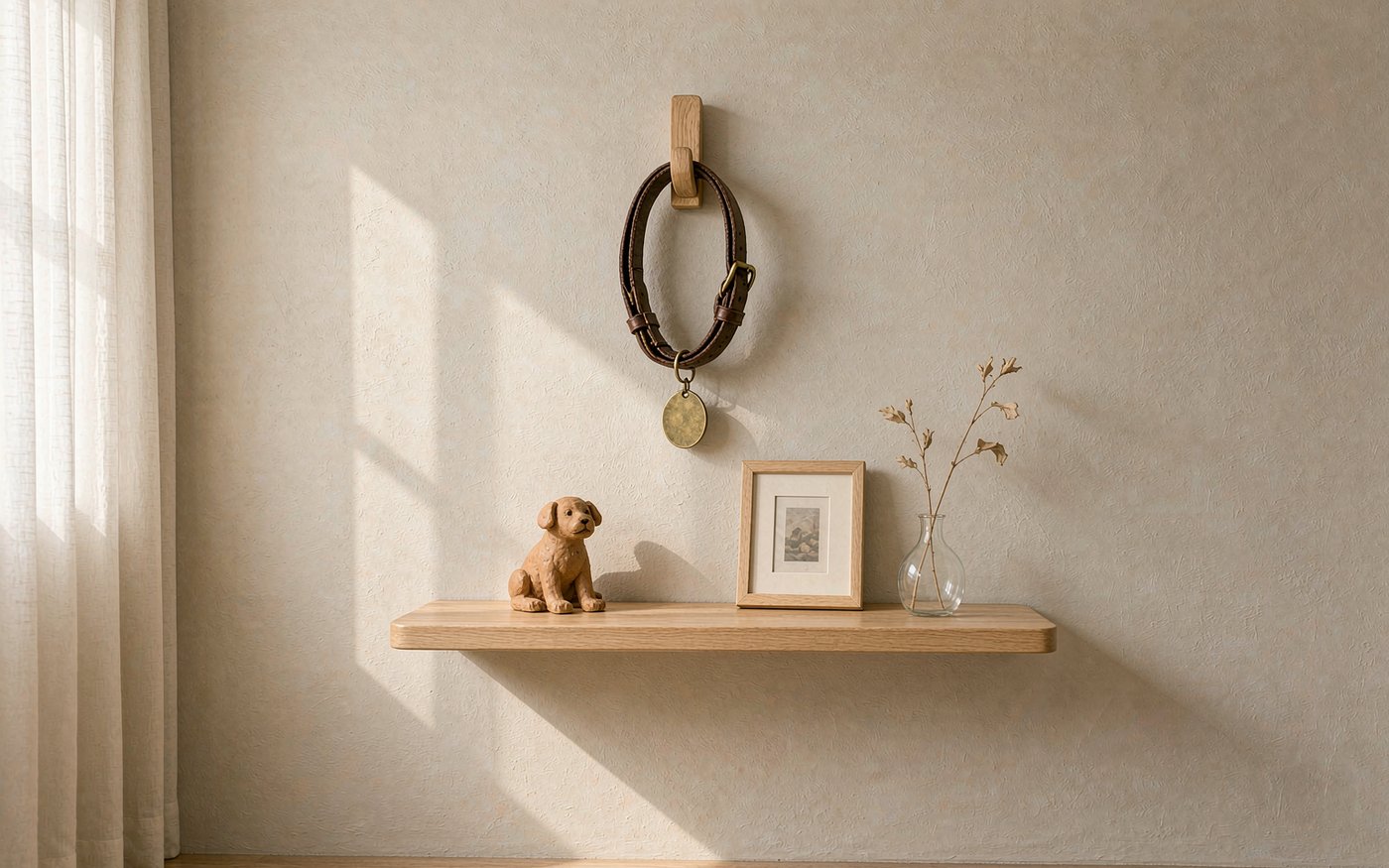
The simplest display costs almost nothing: a small hook, the collar, and a framed photo. The collar’s shape — curled, worn, still holding the impression of a neck — is instantly recognizable to anyone who loved them. A shelf beneath it can hold a candle, a small figurine, or nothing at all.
If you want the portrait beside the collar to be something more personal than a snapshot, our guides to custom pet portrait ideas and how to memorialize a dog cover options from hand-painted glass to hand-sculpted clay. Cat families, we have not forgotten you — the same ideas apply, adapted in cat memorial ideas.
Create a memory box
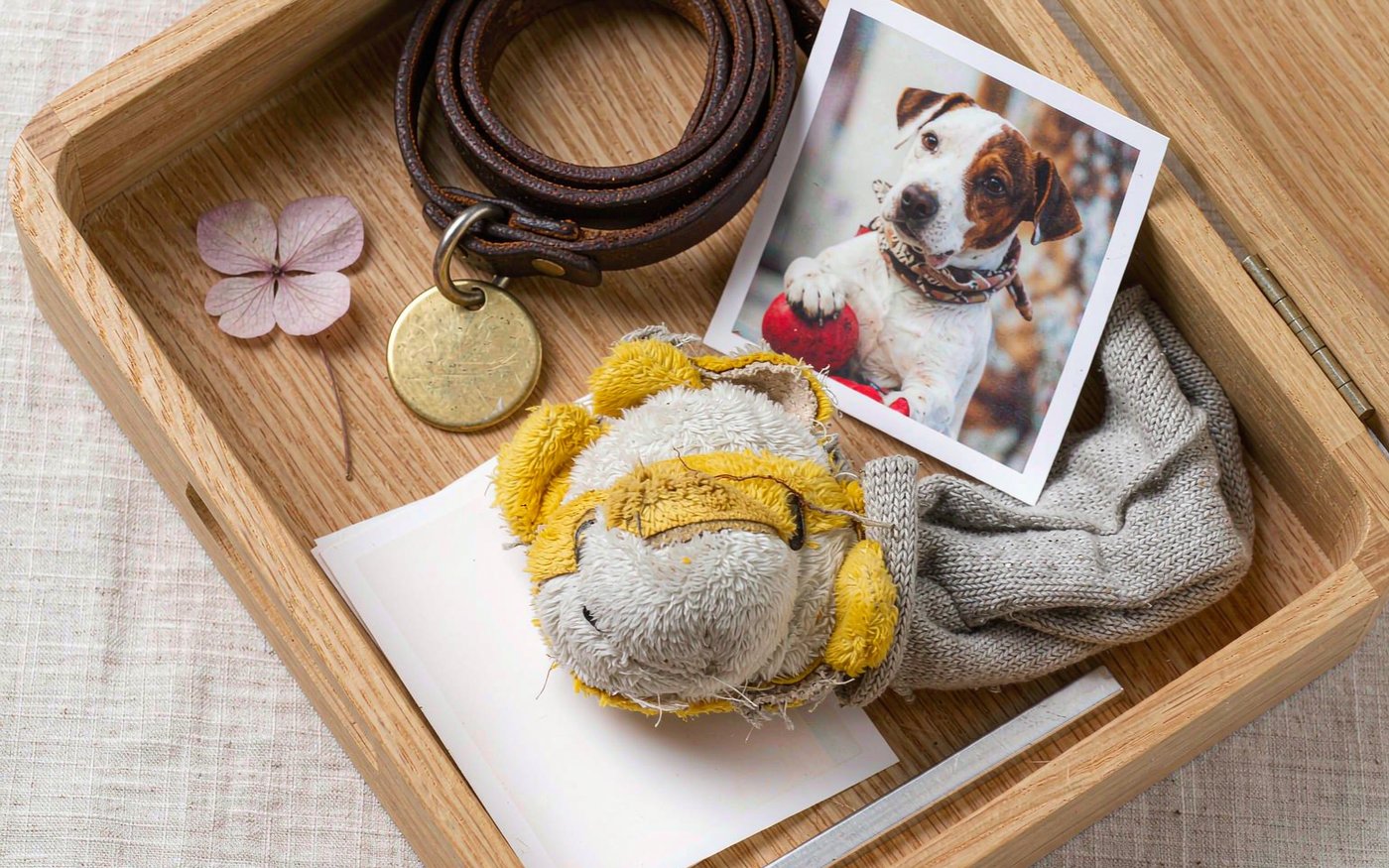
A memory box is the classic for a reason. Line up the collar and tag, one favorite toy, a piece of blanket, sympathy cards, a printed photo, maybe a fur clipping from the vet. Write a short letter to your pet and fold it in — starting with “what I never want to forget about you” is easier than starting from a blank page. A paw print keepsake belongs here too — clay or ink, and it can still be captured even on short notice.
Keep the box somewhere you can reach it. The point is not storage; it is having a single place to visit when you need to.
Make a shadow box
A shadow box turns belongings into wall art: collar arranged in a curve, the tag, a small toy, a photo, perhaps a ribbon or bandana. It works especially well for pets with a distinctive collar or a career — show ribbons, agility awards, working gear. You can assemble one yourself in an afternoon, or ask a local framer to do it properly.
Turn the ID tag into something you carry
The ID tag is often the most personal object a pet leaves behind — their name, your phone number, the sound you knew by heart. Many owners keep the tag on a keyring so that a piece of their pet travels with them every day. If you want something made for the purpose, our custom pet photo keychain carries their portrait, and the custom pet ID tag can be engraved with the same details your dog or cat wore for years. A portrait bookmark serves the same wish for readers.
Commission a portrait that includes their favorite things
Ask any artist what makes a pet portrait feel true, and they will tell you: the details. The toy they carried everywhere. The collar that outlived three harnesses. Our guide to personalized pet memorial gifts explains how a handmade piece can include those specifics — and our hand-sculpted clay figurines are built from photos precisely so that the little markers of a life are not lost. For pets who have been cremated, a portrait displayed beside an urn is one of the most common combinations owners choose; how to choose a pet memorial urn covers the display sizes.
Repurpose the bowl in the garden
The food bowl is the item people most often want out of the kitchen but cannot throw away. Turn it into a planter — cat grass, succulents, forget-me-nots — and it becomes a small living tribute instead of a painful reminder. More ideas like this are in our guide to pet memorial garden ideas.
Donating in Their Name
When the personal items are separated out, what remains — extra blankets, unopened food, the spare leash, toys that were never favorites — can do real good. Most animal shelters and rescues gratefully accept gently used beds, blankets, towels, leashes, collars, and unopened food and treats.
Two practical notes. First, call ahead: acceptance policies vary, and some organizations cannot take opened food or used soft goods. Second, if you want the donation to carry your pet’s name, many rescues will accept it with a note — “in memory of Molly, who loved squeaky toys and every person she ever met.” Some organizations can even acknowledge tribute gifts. Ask; the worst answer is no.
Donating does not mean the items did not matter. It means they go on being useful, which is its own kind of tribute.
What to Discard, and How to Do It Safely
Some items should not be kept or donated, and letting go of them is not a betrayal. These include:
- Expired or opened medications. Never share prescription medication with another animal, and do not flush it. Ask your veterinarian or pharmacy about take-back programs — many have them, and they will make sure disposal is safe.
- Items from an infectious illness. If your pet was treated for a contagious condition, ask your vet which items can be safely disinfected and which should be discarded. When in doubt, discard.
- Heavily worn or broken items. Toys with torn seams and exposed stuffing, cracked bowls, chewed plastic, and collars or leashes near breaking point should not pass to another animal.
- Anything that causes you distress every time you see it. Keeping an object out of guilt helps no one, including their memory.
Throwing something away does not shrink what your pet meant. The love is not stored in the objects. It is stored in you, and in the people and animals your pet shaped.
If Other Pets Are Still at Home
Multi-pet households add a layer: some of these things now belong, in a practical sense, to another animal. A few things owners commonly observe — every animal is different, so watch yours rather than following a rule:
Before you sort anything, it helps to know what the animal left behind is going through: see our guide on whether pets grieve, which covers the behavior changes to expect and how long they usually last.
- Scent matters. Many owners report that a surviving pet seeks out the departed animal’s bed or toys. Leaving one or two items available can be comforting to them.
- Watch for tension over shared items. If resources are few, mild guarding can appear. Offering more than one bed and more than one set of bowls usually settles it.
- A “bridge” object helps. When you are ready to donate or store most things, keeping one familiar toy or blanket out for the surviving pet often eases the transition for both of you.
- Change can be gradual. You do not need to rearrange the house in one weekend. Small, unhurried changes give everyone — animal and human — time to adjust.
More on this is covered in coping with pet loss, including how surviving animals often grieve in their own ways.
If Children Are Part of the Family
Belongings are often the hardest part for kids, because objects are how children hold on. A few approaches that work:
- Let each child choose one item to keep — their own choice, not one assigned to them.
- Store rather than discard when a child is not ready to let go. Revisit the box together in a few months.
- Name the plan out loud in simple words: “We are going to keep Rusty’s collar in a special box so we can visit it. His bed will help another dog feel comfortable.”
Our full guide on helping a child cope with pet loss goes deeper on age-appropriate language and rituals, including ways to use keepsakes so children have something to hold.
Frequently Asked Questions
How long should I wait before going through my pet’s belongings?
As long as you need. Some people sort within days because an untidy house feels unbearable; others wait a year. If you genuinely do not know, a reasonable middle path is to gather everything into boxes without deciding anything — sorting is far easier than choosing, and it buys you time.
Is it strange to keep my pet’s collar after they die?
No. It is one of the most common keepsakes owners keep, and one of the most personal — the collar carried their name and your phone number through every day of their life. There is nothing strange about keeping it, hanging it, or carrying the tag with you.
What can I make with my pet’s collar or ID tag?
Owners most often frame the collar beside a photo, curl it inside a shadow box, hang it from a hook on a memorial shelf, or attach the tag to a keyring. The tag can also be incorporated into a photo keychain arrangement — a portrait on one side, their original tag on the same ring.
Should I bury my pet with their collar?
Many owners do, and many others keep the collar precisely because it is the one object they want at hand rather than underground. Both are normal. If your pet is cremated, some people place the collar beside the urn or coil it around its base; others keep it in a memory box. If you are still weighing aftercare options, what to do with your pet’s ashes covers them.
A Last Thought
Sorting a beloved pet’s belongings is one of the quiet, unglamorous tasks of grief — and one of the ways love gets somewhere to live. You do not need to keep everything to prove they mattered. A collar on a hook, a tag in your pocket, one toy in a box: that is enough. The rest of them lives in you, every day, without needing proof.
If you would like a keepsake that carries their likeness rather than their things, our hand-sculpted pet figurines and hand-painted glass portraits are made to order from photographs. And if you have a story about the things your pet left behind, we would genuinely like to hear it — you can share it with us here. And if you would like to turn one of their belongings into a keepsake for someone else who loved them too, our pet loss gifts guide has ideas that start from exactly that.
A note from our studio
We are a small studio, and everything here is made to order — from a hand-sculpted clay portrait to a printed keepsake that carries a single photograph. Nothing on this site is stock waiting in a warehouse. That is why a piece takes two to four weeks instead of two days.
It also means we are the ones who open the emails. If you write to us about a pet you lost, you are not reaching a support queue — you are reaching the people who will be holding the work in their hands.
And if you have a story you would like to tell, whether or not you ever order anything, there is a place for it here: Share your story. We read every one ourselves, and nothing is published without your permission.
If you are reading this in the first hard weeks: we are sorry. Take the time you need.
— Fingking Studio