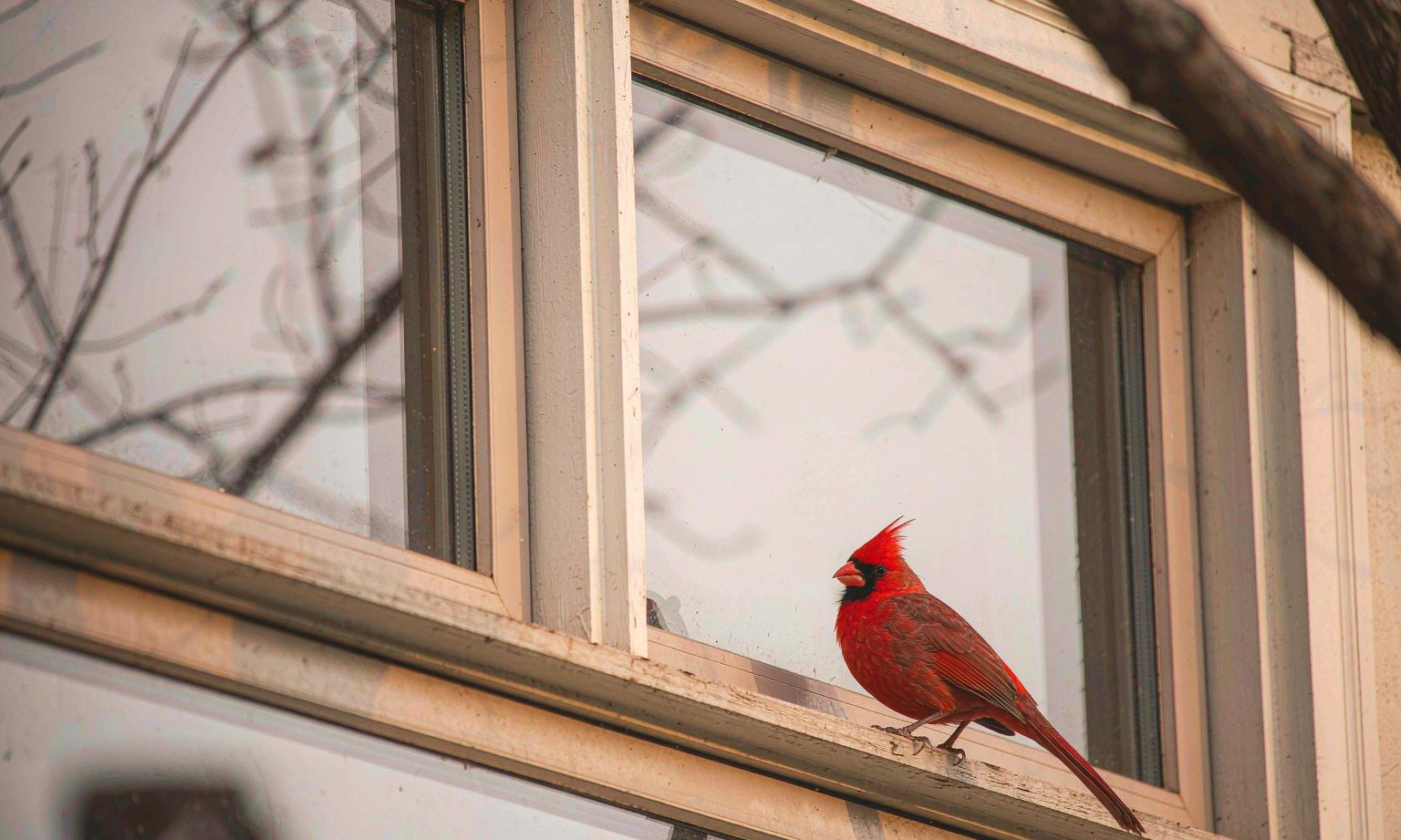
Not long after a pet dies, many people start to notice things. A cardinal that lands on the windowsill and looks in. A dream so vivid it feels like a visit. The sound of paws on the hallway floor in an empty house. A cloud shaped unmistakably like a cat stretching.
And then comes the question underneath all of it: is that them, or is that just me?
This guide handles that question honestly. We will go through what people commonly report, where symbols like the cardinal come from, what science can and cannot say about it, why the grieving mind does this — and the part almost nobody writes about: what it means if you feel nothing at all. No mysticism we can’t back up, and no dismissiveness either. Both would be a disservice to you.
In this guide
What People Commonly Report
Ask around and you’ll hear the same handful of experiences over and over. None of them is rare, and none of them is strange. This is what the landscape looks like:
- Birds, especially cardinals. In the eastern United States, a cardinal appearing at the window or feeder is the single most reported “visit.” Butterflies and dragonflies run a close second, especially landing on a hand or lingering on a grave marker.
- Dreams. Not ordinary anxious dreams, but the vivid, calm kind: the pet is healthy again, walks in, and just is. Many people describe waking up feeling, for a few seconds, that nothing was wrong.
- Sounds. The jingle of a collar, the specific creak of a food bin, a bark that sounds like theirs coming from another room, the thump of a cat landing on the bed at 3 a.m.
- Scents. Their smell on a blanket that was just washed, the shampoo smell weeks after the bath, the smell of their kibble with no bag in the house.
- Electrical oddities. Lights flickering, a favorite song arriving on the radio at the exact right moment. Vague, but people report it constantly.
- Shapes and patterns. A heart in a clump of fur, a paw-shaped cloud, the outline of a dog in a candle flame. Once you’re looking for them, they’re everywhere.
- The sense of presence. The hardest to describe and the most common: a feeling that the house isn’t entirely empty, strongest in the places they loved to sleep.
If one or more of these has happened to you, you’re in enormous company. A meaningful share of bereaved people — of all kinds of losses, not only pets — report experiences like these. They are one of the most widely documented parts of grieving, across cultures and across centuries.
The Cardinal, the Butterfly and Why Them
Why cardinals and butterflies and not, say, raccoons or geese? The answer is culture, not physics, and knowing where the symbols come from makes the whole subject easier to think about.
The cardinal’s role as a messenger is largely a North American folk belief, reinforced constantly by greeting cards, garden stones and social media posts: “cardinals appear when angels are near.” It’s a lovely line. It is also a line from a card, not from anywhere verifiable. Butterflies carry similar weight across many cultures — transformation, the soul leaving the cocoon — and appear in funeral and memorial traditions on several continents independently.
This doesn’t make the cardinal less meaningful to the person who sees one the morning after saying goodbye. It does mean the symbol is shared, which matters for interpreting your own experience: if you grew up in a culture that tells you cardinals are visits, you are far more likely to notice a cardinal, and to encode it as a visit, than someone who grew up without that story. The meaning comes partly from the story. That’s worth knowing, and it doesn’t ruin anything.
What Science Can and Cannot Say
Here is the honest position, stated plainly.
There is no scientific evidence that dead pets, or dead people, can send signs. No controlled study has ever demonstrated communication from the deceased. Anyone who tells you otherwise — that the flickering light was your dog — is claiming to know something no one can currently know, and you should be cautious about anyone selling certainty on this subject.
And: the experiences themselves are real events with real effects. Researchers who study bereavement have documented them for decades; the term after-death communication exists in the grief literature precisely because so many grieving people report them. Psychical researchers have catalogued thousands of cases; mainstream grief researchers, who make no claim about the source, still take seriously that the experience is common and often profoundly comforting. Both things are true at once: unexplained origin, well-documented experience.
That is the honest middle. It is not a fence-sit; it is what the evidence actually supports. Science cannot tell you the cardinal wasn’t your dog. Science can tell you there is no verified case of any cardinal ever being anyone’s dog. What you do with that gap is genuinely up to you — and the next two sections are about how people navigate it in practice.
Why the Mind Does This — and Why It Isn’t a Problem
Even without any claim about the supernatural, the mechanics of these experiences are well understood. Four ordinary processes, running in a brain that just lost a daily companion of many years, produce nearly everything on the list above.
Attention: you are now scanning for them
For years, part of your brain tracked the sound of tags, the shadow under the desk, the particular way the floor creaked. That tracking doesn’t shut off when the pet dies. You are now a detector running with no signal — and detectors with no signal start firing on noise. That’s why the car that sounds like theirs, the bark from another yard, arrive in the first weeks especially.
Pattern-matching: meaning is assigned, not received
Human brains are relentless meaning-makers. A bird at the window is just a bird until a grieving mind — one that has been thinking about its dog every waking hour — assigns it. Once assigned, memory does the rest: you’ll remember the visit, not the nine cardinals last spring you never noticed. This is called confirmation bias, and it isn’t a character flaw; it’s a default setting every human shares.
Dreams: the brain’s night shift
Dreams are where the brain processes what waking life can’t yet. Grief researchers have found that vivid dreams of the deceased are extremely common, and that they often shift over time — from distressing, to neutral, to the calm “visitation” kind. The calm kind is usually a marker that some of the processing has been done. It’s not evidence of a visitor; it is evidence that you are, slowly, doing the work of integrating the loss.
Meaning-making: this is what grief is for
All of this folds into what grief researchers call continuing bonds — the finding, now well established, that people don’t “get over” a loss by severing the bond, but by transforming it into something they carry. A cardinal at the window, a dream, a flicker — these are the bond, transforming. The experience isn’t a malfunction of grieving. Increasingly, it looks like the mechanism of it.
For more on the shape this takes over months, see how long grief lasts after losing a pet — the timeline there pairs directly with how these experiences usually evolve.
What If You Feel Nothing?
Now the section that almost nobody writes, and the one we’d most like you to read.
If you’re here because you’ve heard about signs — from friends, from the internet, from a sympathetic aunt who just knows your cat sent the butterfly — and you’ve experienced nothing. No dreams. No cardinals. No flicker, no presence, nothing. Just an ordinary, silent house.
It is very easy to slide from that into something corrosive: maybe they’re not visiting because they didn’t love me. Maybe I did something wrong. Maybe other pets loved their people more.
So let’s be as clear as this page can be: the absence of signs is not a message. Not in the supernatural frame — there is no verified mechanism by which a pet would “choose” to send signs, so there is no logic by which silence means anything. And not in the psychological frame either: people who report signs tend to be more suggestible, more imagery-prone, more emotionally flooded, and are more often actively grieving the acute early phase. People who experience grief more quietly, or further along the timeline, report far fewer of them. That’s the entire difference. Nothing about love is measured here.
Plenty of deeply loved pets leave behind silent, ordinary Tuesdays. Plenty of people who received nothing but silence loved their animals as well as anyone has ever loved anything. If this is you: the silence is not their voice. It’s just quiet.

If the Signs Comfort You, Let Them
Some people, having read the science section, worry that “knowing it’s probably my brain” will take the comfort away. In practice it usually doesn’t, and grief researchers have a decent explanation: the comfort doesn’t come from the metaphysics. It comes from the moment — from pausing, remembering, feeling the bond light up for a second. Whether a cardinal is a messenger or a trigger for a memory, the pause is identical. The warmth is identical.
You are allowed to keep the cardinal without deciding what it is. You are allowed to say “thanks, buddy” to a butterfly without writing a metaphysical thesis. Grief is hard enough without demanding that every comfort be fully justified. If a sign gives you a moment of peace, take it — no belief required, no apology necessary.
The only caution: comfort that requires the signs — that starts to feel like the only channel left — is worth watching, and the next section is about that.
When It’s Time to Talk to Someone
Almost everything in this article is a normal, healthy part of grieving. A small number of experiences are not, and it’s worth knowing the difference — not to alarm anyone, but because people rarely volunteer this information and the line matters.
Consider talking to a grief counselor or your doctor if:
- You are awake and alert and consistently perceiving your pet as physically present — not a flicker, not a feeling, but sustained perception you cannot shake.
- The signs have become the main structure of your day, and ordinary life — work, meals, other relationships — is thinning out around them.
- You find yourself making significant decisions (spending money, changing routines, avoiding places) primarily to invite or manage the signs.
- It has been many months and the intensity hasn’t softened at all — the persistent, unhealed form of grief is a recognized condition, and it responds well to treatment. More on that in our grief timeline guide.
None of this is a judgment and none of it means you’re “crazy.” Grief does strange, powerful things to perception, and clinicians see this constantly. Reaching out is not an overreaction; it’s the same thing as taking a limping pet to the vet.
If children are part of your household and you’re fielding these questions from them, helping a child cope with pet loss covers the conversations specifically — kids tend to ask the metaphysics questions adults are too polite to ask.
Signs You Can Make Yourself
Here is the practical turn, and the one we can actually help with. Whether or not the universe sends confirmation, you can make reminders that are physical, real, and entirely within your control.
- Keep something that carries their scent. A collar, a folded blanket, a piece of their bedding in a sealed bag. Scent is the most powerful memory trigger there is, and it is real — no interpretation needed. We wrote a full guide on what to do with a pet’s belongings, including what to keep and what to let go.
- Save a strand of fur or a paw print. If your vet has them, or you kept a lock of fur, it is the most literal piece of them that exists. If you didn’t manage to take a paw print before goodbye, our guide to paw print keepsakes covers the options that still exist afterwards.
- Commission a portrait from your photographs. A hand-sculpted figurine or a hand-painted glass portrait, made from the photos you already have, puts their actual face somewhere you’ll see it daily. Of every “sign” on this page, it is the one with the most resemblance.
- Write down the experiences you do have. The dream, the cardinal, the 3 a.m. sound. Grief memories blur fast; a dated note in your phone preserves them honestly. Later, the record matters more than the interpretation — and some people eventually make it into something permanent: an album, a letter, a line engraved on a wooden memorial urn.
And if you’re assembling any of this into something for someone else who is grieving, our guides to pet loss gifts and personalized pet memorial gifts sort the options by budget and relationship.
Frequently Asked Questions
What does it mean when a cardinal appears after a pet dies?
In North American folk tradition, a cardinal is understood as a visit from a departed loved one. There’s no scientific evidence for this — the belief is cultural, spread by cards, songs and social media. If seeing one gives you comfort, the comfort is real regardless of the mechanism, and you’re in very large company.
Is it normal to dream about my dead pet?
Yes — it’s one of the most common grief experiences there is, reported across all kinds of losses. Dreams often shift over time from distressing to calm and vivid. Grief researchers generally read the calm ones as a sign that the mind is integrating the loss, which is a healthy trajectory, not an eerie one.
Why do I hear my dog’s paws or collar after he’s gone?
Because part of your brain spent years tracking those exact sounds and hasn’t stood down yet. It’s an attention effect, not a haunting, and it fades as the months pass — though many people say they miss it when it does.
My pet died but I’ve had no signs at all. Does that mean something?
No. It does not mean they didn’t love you, and it does not mean you did anything wrong. There’s no verified mechanism for signs, so silence can’t carry a message. Quiet griefers and vivid experiencers love their pets equally; they just process loss differently.
Are butterflies a sign from a deceased pet?
Butterflies symbolize transformation and the soul across many cultures, which is why they’re the most commonly reported sign worldwide after birds. Symbolically rich, evidentially empty — like all of these. The meaning is real; the mechanism is unproven.
Should I be worried that I’m imagining all of this?
Occasional experiences — a sound, a dream, a presence, a pattern — are entirely normal and not a mental health concern. If you’re perceiving your pet as physically present while fully awake, or the experiences are restructuring your daily life, that’s the point to talk to a doctor or grief counselor. Both situations are common; only one needs support.
Can my other pet sense their spirit?
What surviving pets demonstrably sense is the absence: the missing scent, the missing routines. Whether they perceive anything beyond that is unknowable. What looks like “sensing a spirit” — watching a spot, visiting the grave — is better explained by them missing a companion, which is its own real and tender thing. More on this in do pets grieve.
How long do these experiences keep happening?
There’s no fixed schedule. Many people report the sensory experiences fading over the first year as attention effects wear off, while dreams and “presence” moments can continue for years, especially around anniversaries. Some people keep them for life and count it a gift. All of it is within the range of normal.
A Quiet Explanation Isn’t a Less Loving One
Whatever you decide the cardinal was — messenger, memory, or a bird with no agenda at all — the fact underneath it doesn’t change: something in you wanted it to be them, and wanting that is what love looks like when it has nowhere left to go in person.
Take the comfort where you find it. Keep something real where you can. And if the silence where the signs should be is what brought you here — the silence isn’t a verdict. It never was.
A note from our studio
We are a small studio, and everything here is made to order — from a hand-sculpted clay portrait to a printed keepsake that carries a single photograph. Nothing on this site is stock waiting in a warehouse. That is why a piece takes two to four weeks instead of two days.
It also means we are the ones who open the emails. If you write to us about a pet you lost, you are not reaching a support queue — you are reaching the people who will be holding the work in their hands.
And if you have a story you would like to tell, whether or not you ever order anything, there is a place for it here: Share your story. We read every one ourselves, and nothing is published without your permission.
If you are reading this in the first hard weeks: we are sorry. Take the time you need.
— Fingking Studio