When someone you care about loses a pet, you want to say something that helps — and instead you freeze at the blank card. Not because you don’t care, but because pet grief is confusing territory: how sad are you allowed to be about a dog? (Very.) Do you mention it at work? (Gently, yes.) What do you write that doesn’t sound like a greeting card you didn’t mean?
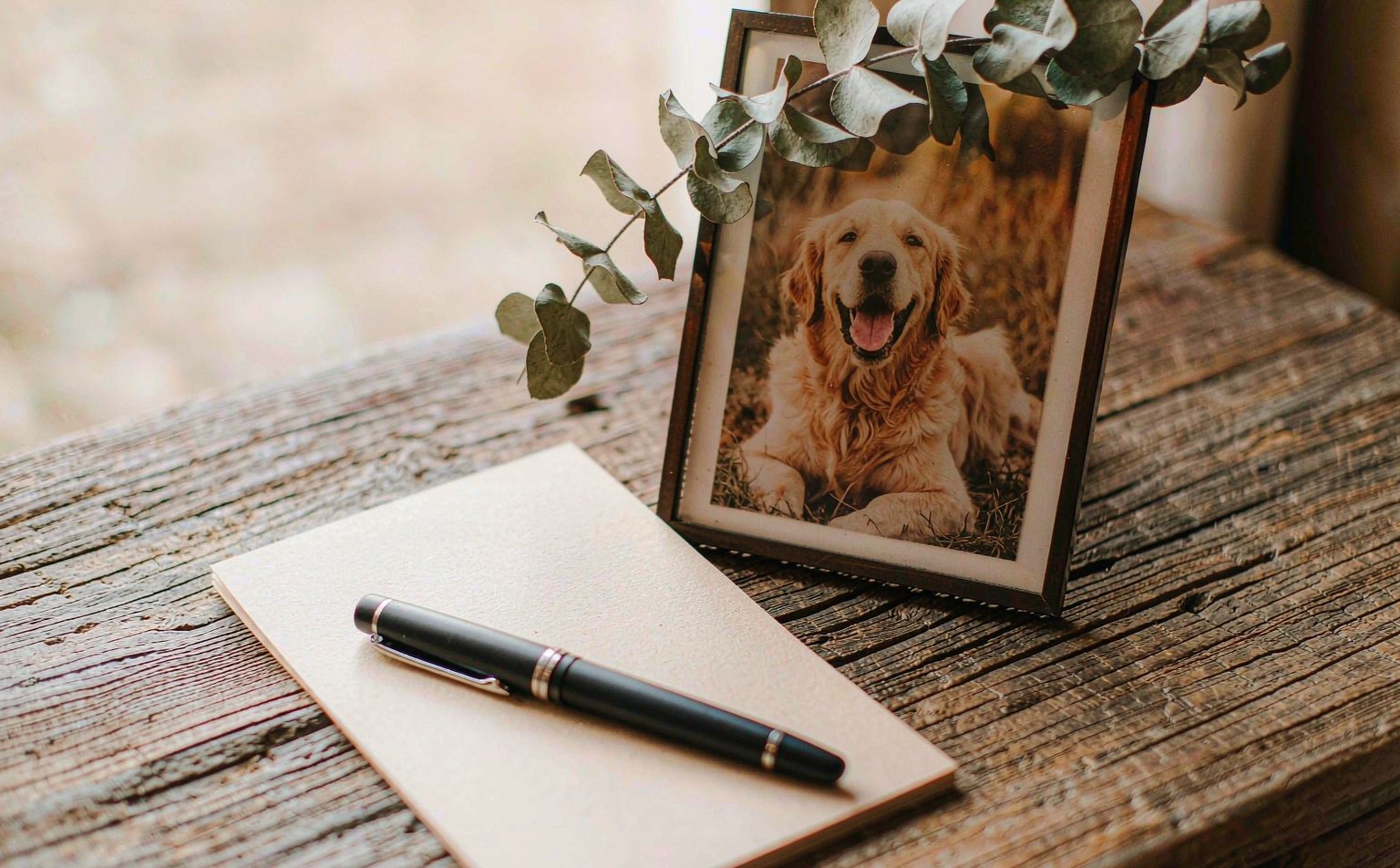
This guide gives you 46 ready-to-write messages sorted by who you’re writing to and what happened, plus the three sentences that make almost any message land, the phrases that quietly hurt, and what to write weeks or a year later when everyone else has gone quiet.
First: Why This Card Matters More Than You Think
Pet loss is what grief counselors call a disenfranchised loss. The relationship was real — often more hours together than most human friendships — but the mourning around it is quiet and unacknowledged. People go back to work the next day. Nobody sends flowers. Friends say “so, are you getting another one?”
That’s why a card carries more weight here than it would after a human funeral. You are not just saying “sorry.” You are saying I saw them too, and what you lost was real. It takes three sentences. Those three sentences are the entire job.
The Three-Sentence Formula That Almost Always Works
Forget eloquence. Use this structure:
- Sentence 1 — use the pet’s name. “I’m so sorry about Bella.” A name proves you saw them as an individual, not a category.
- Sentence 2 — acknowledge the bond. “I know how much she meant to you.” This validates the size of the grief without trying to shrink it.
- Sentence 3 — a specific memory or a concrete offer. “I still think about the way she waited by the door for you.” Or: “I’m bringing dinner Thursday — no need to answer.”
Two or three sentences are plenty. Longer isn’t warmer. If you’re truly stuck, honesty works: “I don’t have the right words, but I’m so sorry, and I’m thinking about you.” Nobody has ever been comforted less by that.
One rule sits underneath all of it: never rush them toward feeling better. Grief doesn’t want to be fixed. It wants company.
46 Messages, Sorted by Who You’re Writing To
For a close friend or family member
- I’m so sorry about [name]. Thinking of you today and every day this week.
- [Name] was such a good soul, and nobody in the world loved them better than you did.
- I know how much [name] meant to you. There’s no rush to be okay.
- [Name] was your family, and I’m grieving with you. They mattered to me too.
- The place is going to feel quiet for a while. I’m right here whenever you want company.
- I keep thinking about [insert a small, specific habit of the pet]. What a character.
- You gave [name] the kind of life every animal deserves — a whole lifetime of being safe and loved.
- Sending you so much love as you say goodbye to your best friend.
- Whatever you’re feeling right now — numb, angry, fine one hour and wrecked the next — it’s allowed, and it makes sense.
- If you want to talk about [name] for two hours, I’ll listen for two hours. If you want to talk about anything else, I can do that too.
- I’m bringing dinner over on Thursday. You don’t have to answer the door or say a word.
- Your love for [name] was obvious to everyone who ever saw the two of you together. That doesn’t disappear.
For a coworker, neighbor, or someone you don’t know well
- So sorry to hear about [name]. Please take whatever time you need — a loss like this is real.
- Thinking of you today. I know how much [name] meant to you.
- I’ll miss seeing [name] on your morning walks. What a lovely companion.
- I was sorry to hear about your dog. Please don’t worry about anything here — we’ve got it covered.
- No need to reply to this. Just wanted you to know I’m thinking about you.
- Losing a pet is losing family. Be gentle with yourself this week.
Note for the workplace: a short message on a card or in a private DM is right. A long, emotional note or a public post is not. Keep the dignity with them.
When the loss was sudden — an accident, an illness that moved fast
- I can’t imagine the shock of losing [name] so suddenly. Please lean on me — I’m not going anywhere.
- There’s no way to brace for a goodbye you never saw coming. Be extra kind to yourself.
- A sudden loss steals the chance to say everything. But [name] felt your love on every ordinary day, and that’s what counted.
- If you keep replaying the last day in your head, that’s not a failure of grief — that’s love looking for somewhere to go.
- I’m not going to ask what happened. I’m just going to ask what you need.
When they had to make the decision — illness or euthanasia
- Letting [name] go was the last, hardest act of love in a lifetime of loving them well.
- You carried the pain so [name] wouldn’t have to. That’s the bravest thing I know.
- Choosing peace for them took more courage than most people will ever understand. You did right by them.
- Please don’t second-guess yourself with “what ifs.” Everything you did, you did for [name].
- [Name] was warm, safe and loved right up to the last moment — because of you.
- There’s no “right time” for a goodbye like this, and no wrong one either. You did it out of love.
For a child who lost a pet
- Your pet loved you so much, and that love doesn’t disappear — it just changes shape and stays with you.
- It’s okay to be really sad, and it’s also okay to laugh at the funny things they did. Both mean you loved them.
- You were such a good friend to [name]. They were lucky you were theirs.
- If you want to draw a picture of [name] or tell me your favorite story about them, I’d love that.
If they lost a dog
- No one will ever be as happy to see you as [name] was. That kind of love doesn’t come around twice easily.
- Some dogs leave paw prints. Yours left a whole path across your life.
- [Name] gave you a lifetime of loyalty and asked for almost nothing back. What a gift to have had.
- A house never quite sounds the same without a dog in it. I’m so sorry.
If they lost a cat
- Cats don’t give their hearts lightly, and [name] gave theirs to you. That bond was rare and real.
- Home won’t sound the same without that quiet little presence. I’m so sorry for the silence they left.
- The sunny spot [name] claimed every afternoon will ache for a while. Those were their spots because they loved you.
- [Name] was a beautiful, gentle presence in your home. The house won’t feel like itself for a while.
Weeks later, or on the anniversary
These may be the most valuable messages on this page. A month after the loss, everyone else has moved on — and the person grieving usually has not. Remembering out loud, later, is a rare gift. Our guide to coping with pet loss covers why the second month can be the hardest.
- I was thinking about [name] today. That photo of [them doing a funny thing] still makes me smile.
- It’s been a month, and I know it doesn’t work that way — but I wanted you to know I haven’t forgotten [name].
- I know this week is the anniversary. I’m thinking of you and of [name].
- I still say [name]’s name when I think of them, because they existed and they mattered.
- No occasion. Just wanted you to know [name] is still remembered in this house.
What Not to Say — and What to Say Instead
Almost everyone who says something hurtful means well. The problem is that certain phrases quietly tell a grieving person their loss was small. Here are the common ones, with a kinder swap:
- “At least they lived a long life.” → “What a long, well-loved life they had with you.” The first one argues with the grief; the second honors the life.
- “You can always get another one.” → Nothing. Don’t. A pet isn’t a replaceable household item, and this is the single most painful thing to hear.
- “It was just a pet.” → “They were family, and I’m sorry.” Never qualify the relationship for them.
- “I know exactly how you feel.” → “I can’t imagine how hard this is, but I’m thinking of you.” You don’t live in their grief; you stand next to it.
- “Everything happens for a reason.” → “I’m so sorry. There aren’t words for a loss like this.”
- “Are you going to get another dog?” → “Tell me about [name] — what was your favorite thing about them?”
- Silence, because you’re afraid of saying the wrong thing. → Any of the 46 messages above. Saying the imperfect thing beats saying nothing, every time.
Text, Card, Email, or Public Post?
A few small etiquette choices make a big difference:
- A text is fine — especially first, and especially fast. Send it the day you hear. Short is not cold.
- A card is better if you can — handwritten, mailed or handed over. People keep cards. Many people re-read them months later.
- Do not post on their social media unless they have posted first. Public acknowledgment can feel like it takes their news and makes it about you.
- Skip the gift-with-strings. A huge gesture can quietly create the obligation to thank you. Small and pressure-free is the goal.
- Follow up in two to four weeks. One more message, unattached to anything: “Still thinking about you and [name].” It will land harder than the first one did.
- Keep the pet’s name in your vocabulary afterwards. Mentioning them at Christmas, in a message, in passing — that’s how you tell someone their companion existed.
If You Want to Send Something More Than a Card
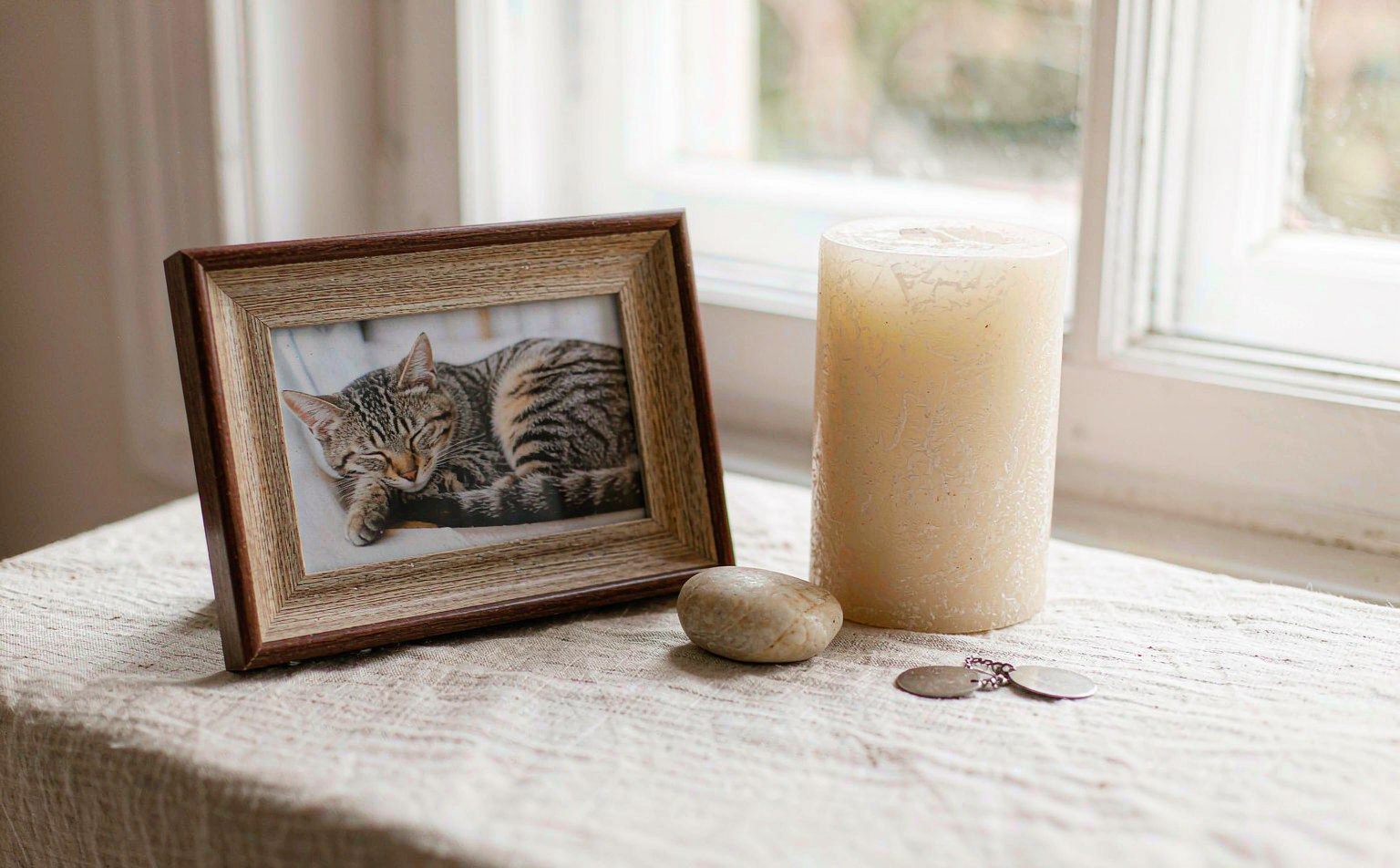
Cards live in a drawer. Some people want to give something that stays out in the open — and a keepsake with the pet’s face on it is the thing grieving owners most often describe as the gift that helped. The trick is choosing something small and easy to receive, then writing your card so the gift never feels like a performance.
A few options that work well, depending on how close you are:
- For a friend, neighbor or coworker — something small and personal they can carry: a photo keychain for the keys they use every day, a portrait bookmark if they read, or a portrait mug for the morning routine the pet used to supervise.
- For someone very close — a piece that stands on a shelf: a hand-sculpted clay figurine, a sculpted head-and-shoulders portrait, or a hand-painted glass portrait. These take a clear photo and a little patience on the turnaround, so order early and tell them it’s coming.
- If they’re still waiting on ashes — don’t rush the urn decision for them. Point them to our guide on how to choose a pet memorial urn and, if they want, offer to read it with them. Sizes and materials are a lot to hold while grieving.
Two cautions. First, if the pet has just died — within days — a keepsake can be too early; a card and company is often the better first move, with the gift following at two or three weeks. Second, never make the gift yourself-crafted-late; an arrival date you can’t hit is worse than no gift. Our pet loss gifts guide sorts more ideas by budget and relationship if you want the full range.
You Don’t Have to Get It Perfect
The people who comfort best are not the most eloquent ones — they’re the ones who show up and say something true. A card with three honest sentences, the pet’s name in it, and no attempt to fix anything beats the perfect sympathy message that never got sent. If you take one thing from this page, take the formula: name it, acknowledge the bond, offer something real. Then send it today, before you talk yourself out of it.
And if you’re reading this because the loss is yours — not a friend’s — start with what to do with your pet’s ashes, our guides on memorializing a dog and cat memorial ideas, and the keepsake ideas built from your own photos. There is no schedule for any of it.
Frequently Asked Questions
What do you say when someone loses a pet?
Use the pet’s name, acknowledge how much they meant, and offer something concrete. Three sentences is enough: “I’m so sorry about Bella. I know how much she meant to you. I’m bringing dinner Thursday, no need to reply.” Avoid anything that minimizes the loss or suggests replacing the pet.
Is it okay to send a card if I never met their pet?
Absolutely. You’re acknowledging their grief, not your relationship with the animal. “I never had the chance to meet [name], but I know how much they meant to you, and I’m so sorry” is warm and completely appropriate.
Should I send a text or a card?
Both, ideally. A text the day you hear, because being seen early matters. A card if you can, because cards get kept and re-read. If you can only do one, a sincere text beats a card you never get around to sending.
What if I say the wrong thing?
You probably will, and it will still help. Grieving pet owners rarely remember a clumsy phrase; they remember who showed up. If a sentence lands badly, a simple “I’m sorry — I don’t know the right words, but I’m here” repairs it immediately.
How long should I keep checking in?
Longer than feels natural. Send one message at two to four weeks, another at any anniversary or birthday you remember, and keep using the pet’s name in conversation. The second month is usually lonelier than the first, because everyone else goes back to normal.
What’s a good gift to send with a pet sympathy card?
Something small, personal, and pressure-free — a photo keychain, a portrait bookmark, or a portrait mug made from a photo they love. If the loss is recent, send the card first and the keepsake at two or three weeks so it doesn’t arrive during the shock.